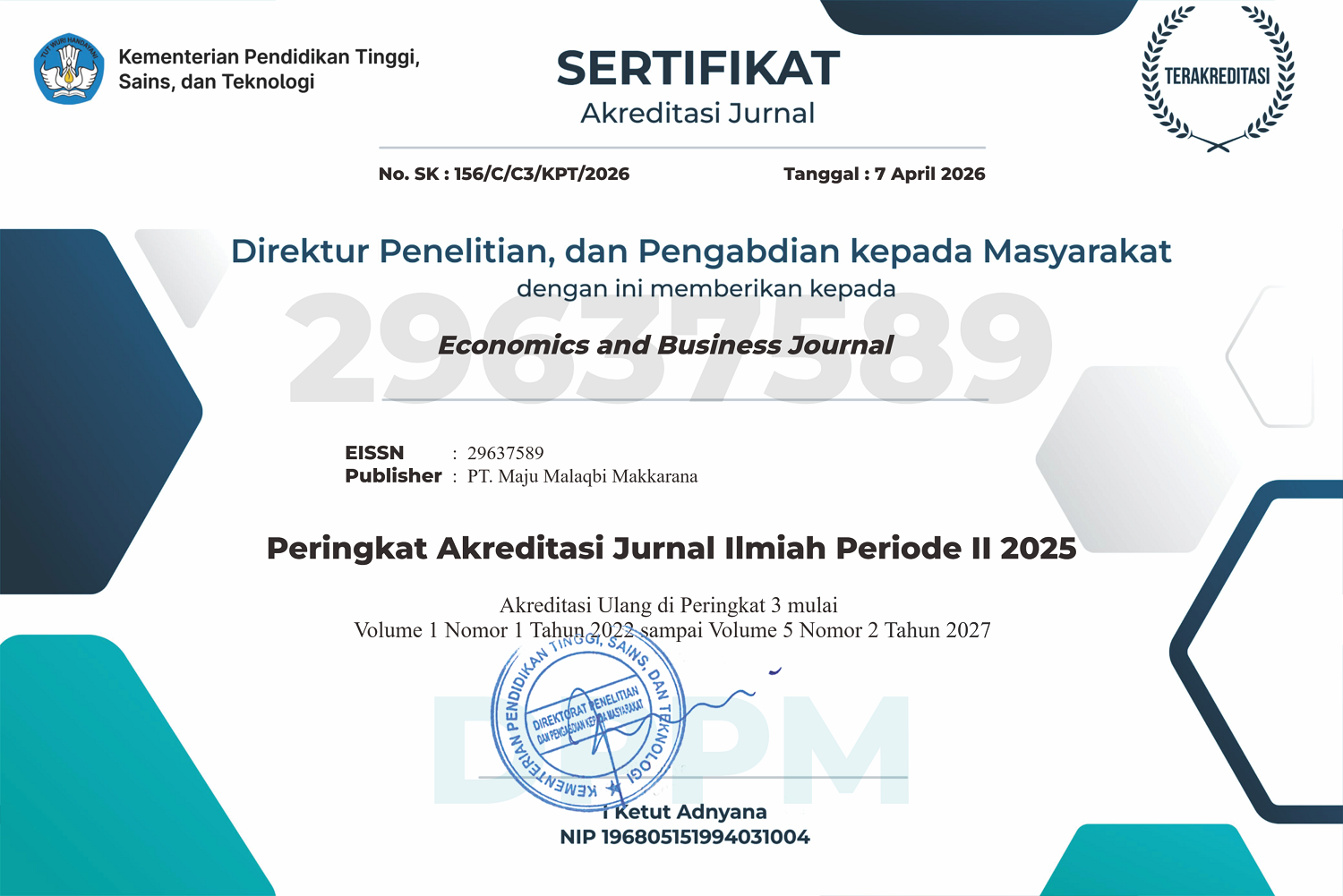

From Justice To Jazz: Exploring The Improvisational Flow Of Support And Citizenship Behaviour In The Hospitality Industry
DOI:
10.47353/ecbis.v4i1.246Published:
2025-11-16Downloads
Abstract
This study aims to analyze the effect of Procedural Justice on Organizational Citizenship Behaviour (OCB) through Perceived Organizational Support (POS) among hotel employees in Makassar City. The research is motivated by the declining extra-role behaviors of employees, which affect service quality, allegedly driven by perceived procedural injustice and low organizational support. Using a quantitative approach and Partial Least Squares Structural Equation Modeling (PLS-SEM), data were collected through questionnaires from employees of three- to five-star hotels. The results reveal that Procedural Justice has a positive and significant effect on both POS and OCB, directly and indirectly. Moreover, POS functions as both a mediator and a moderator, strengthening the relationship between procedural justice and OCB. The R² and Q² values indicate a high explanatory and predictive relevance, while the Goodness of Fit Index confirms the empirical adequacy of the model. These findings support the Social Exchange Theory (Blau, 1964) and Organizational Support Theory (Eisenberger et al., 1986), asserting that fairness and organizational support foster reciprocal relationships that motivate employees to engage in voluntary, extra-role behaviors. This study contributes theoretically by extending the application of social exchange theory within the hospitality context and provides practical implications for hotel management to enhance procedural justice and organizational support as strategies to improve employees’ organizational citizenship behaviour.
Keywords:
Procedural Justice Organizational Citizenship Behavior Perceived Organizational Support Hospitality Industry Employee PerformanceReferences
Blau, P. M. (1964). Exchange and power in social life. New York: Wiley.
Blau, P. M. (2017). Exchange and power in social life. Routledge.
Bryman, A. (2016). Social research methods (5th ed.). Oxford University Press.
Chin, W. W. (1998). The partial least squares approach for structural equation modeling. In G. A. Marcoulides (Ed.), Modern Methods for Business Research (pp. 295–336). Lawrence Erlbaum Associates.
Cho, Y. J., & Kim, M. J. (2019). Procedural justice and organizational citizenship behavior: The mediating role of trust in the supervisor. Public Personnel Management, 48(2), 143–163. https://doi.org/10.1177/0091026018806018
Cohen, J. (1988). Statistical power analysis for the behavioral sciences (2nd ed.). Lawrence Erlbaum Associates.
Colquitt, J. A. (2001). On the dimensionality of organizational justice: A construct validation of a measure. Journal of Applied Psychology, 86(3), 386–400.
Colquitt, J. A., LePine, J. A., Piccolo, R. F., Zapata, C. P., & Rich, B. L. (2013). Explaining the justice–performance relationship: Trust as an exchange deepener and trustworthiness as an uncertainty reducer. Journal of Applied Psychology, 98(1), 199–213. https://doi.org/10.1037/a0030004
Creswell, J. W., & Creswell, J. D. (2018). Research design: Qualitative, quantitative, and mixed methods approaches (5th ed.). SAGE Publications.
Cropanzano, R., & Mitchell, M. S. (2005). Social exchange theory: An interdisciplinary review. Journal of Management, 31(6), 874–900. https://doi.org/10.1177/0149206305279602
Eisenberger, R., Huntington, R., Hutchison, S., & Sowa, D. (1986). Perceived organizational support. Journal of Applied Psychology, 71(3), 500–507. https://doi.org/10.1037/0021-9010.71.3.500
Eisenberger, R., Malone, G. P., & Presson, W. D. (2020). Optimizing perceived organizational support to enhance employee engagement. Society for Human Resource Management and Society for Industrial and Organizational Psychology, 1–22.
Golverdi, M., Alipour, H., & Safarpour, H. (2024). Exploring the mechanisms linking organizational justice and employee service outcomes in hospitality. Cornell Hospitality Quarterly, 65(1), 19–34. https://doi.org/10.1177/19389655231153028
Gong, T., Wang, Y., & Wu, H. (2024). Justice climate and extra‐role behavior in hospitality: The mediating role of perceived support. International Journal of Contemporary Hospitality Management, 36(2), 455–472. https://doi.org/10.1108/IJCHM-05-2023-0601
Grandey, A. A., Gabriel, A. S., & King, E. B. (2021). Tackling taboo topics: A review of the three Ms in working women’s lives. Journal of Service Research, 24(1), 3–23. https://doi.org/10.1177/1094670520933683 (dalam konteks hospitality fairness & emotional experience)
Greenberg, J. (1990). Organizational Justice: Yesterday, Today, and Tomorrow. Journal of Management, 16(2), 399–432.
Hair, J. F., Hult, G. T. M., Ringle, C. M., & Sarstedt, M. (2021). A Primer on Partial Least Squares Structural Equation Modeling (PLS-SEM) (3rd ed.). Thousand Oaks, CA: Sage Publications.
Henseler, J., Ringle, C. M., & Sarstedt, M. (2016). Testing measurement invariance of composites using partial least squares. International Marketing Review, 33(3), 405–431.
Hobfoll, S. E. (1989). Conservation of resources: A new attempt at conceptualizing stress. American Psychologist, 44(3), 513–524. https://doi.org/10.1037/0003-066X.44.3.513
Hur, W. M., Moon, T. W., & Jun, J. K. (2022). The effect of perceived organizational support on service performance: The mediating role of work engagement in the hotel industry. International Journal of Hospitality Management, 102, 103174. https://doi.org/10.1016/j.ijhm.2022.103174
Kao, H. Y. (2023). Procedural fairness and extra-role behavior in service organizations: The conditional role of employee psychological states. Service Industries Journal, 43(7), 512–532. https://doi.org/10.1080/02642069.2022.2054401
Kock, N., & Lynn, G. S. (2012). Lateral collinearity and misleading results in variance-based SEM: An illustration and recommendations. Journal of the Association for Information Systems, 13(7), 546–580.
Liu, Y., Li, J., & Wang, S. (2023). Linking organizational justice to citizenship behavior: The mediating role of perceived organizational support. Personnel Review, 52(5), 1112–1131. https://doi.org/10.1108/PR-03-2021-0215
Moon, T. W., Youn, N., Hur, W. M., & Kim, K. M. (2022). Emotional labor, perceived fairness, and organizational support: Evidence from hotel frontline employees. Service Industries Journal, 42(5–6), 280–301. https://doi.org/10.1080/02642069.2021.1888832
Organ, D. W. (1988). Organizational citizenship behavior: The good soldier syndrome. Lexington Books.
Podsakoff, P. M., Podsakoff, N. P., MacKenzie, S. B., & Klinger, R. (2018). Organizational citizenship behavior: A critical review of the theoretical and empirical literature. Journal of Management, 44(2), 512–563.
Putra, A. R., & Nurhadi. (2021). Pengaruh keadilan organisasi terhadap perilaku ekstra-peran karyawan hotel: Studi kasus pada hotel berbintang di kota Makassar. Jurnal Manajemen Perhotelan Indonesia, 5(2), 115–129.
Rhoades, L., & Eisenberger, R. (2002). Perceived organizational support: A review of the literature. Journal of Applied Psychology, 87(4), 698–714.
Sarstedt, M., Ringle, C. M., & Hair, J. F. (2020). Partial least squares structural equation modeling. In Handbook of Market Research. Springer.
Saunders, M., Lewis, P., & Thornhill, A. (2019). Research methods for business students (8th ed.). Pearson.
Yan, X., Wu, Y., & Zhou, L. (2025). Rethinking justice and social exchange in hospitality employment: An integrative multi-theory perspective. Tourism Management Perspectives, 47, 101087. https://doi.org/10.1016/j.tmp.2024.101087
Yang, F. X. (2021). Organizational justice and service behavior in hotels: A review and future research agenda. Journal of Hospitality and Tourism Management, 47, 305–315. https://doi.org/10.1016/j.jhtm.2021.04.015
License
Copyright (c) 2025 Tenri Sayu Puspitaningsih Dipoatmodjo, Zainal Ruma, Rezky Amalia Hamka, Andi Dewi Angreyani, Hery Maulana Arif

This work is licensed under a Creative Commons Attribution-ShareAlike 4.0 International License.
Downloads
How to Cite