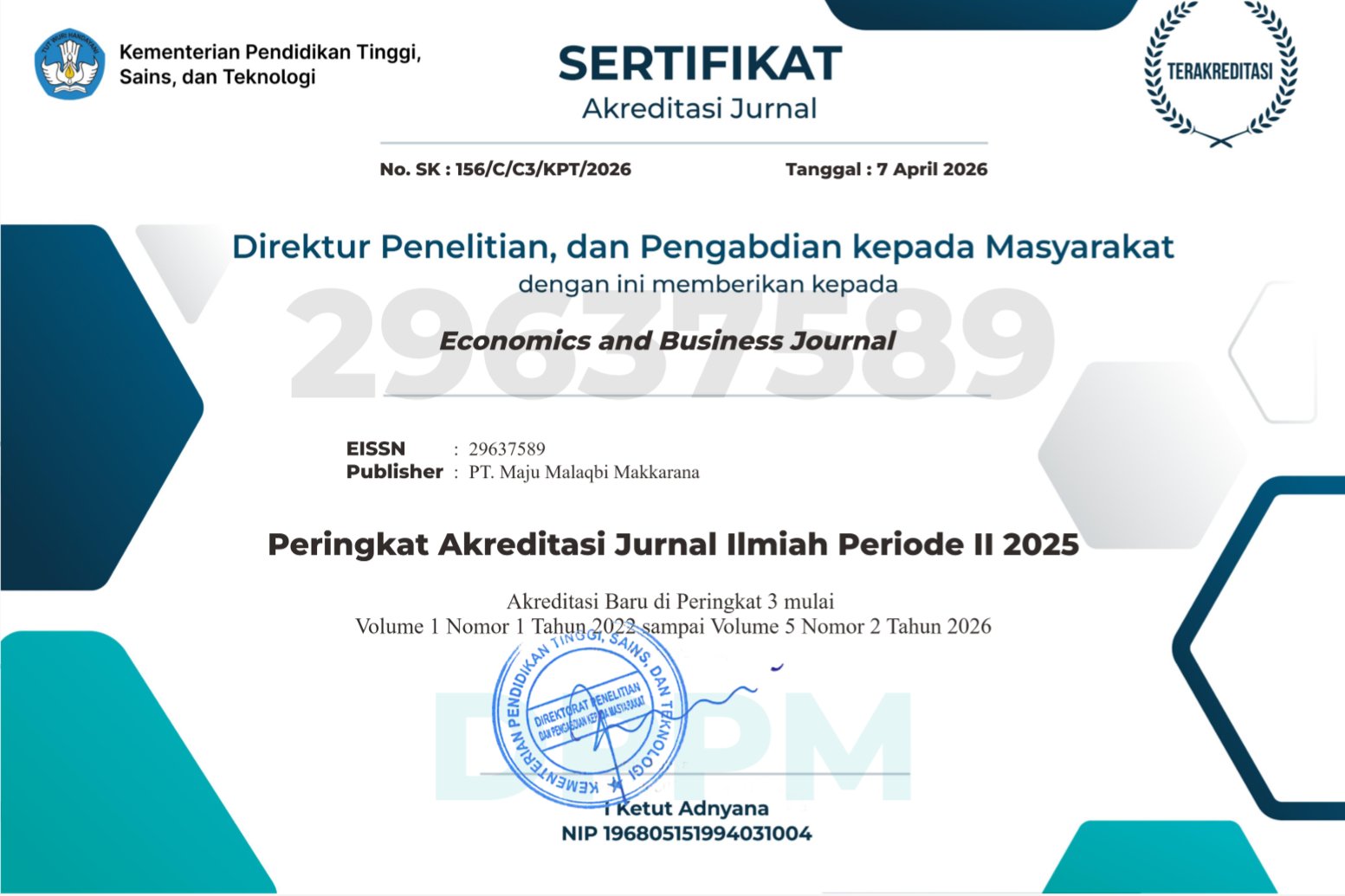

The Economics and Business Journal (ECBIS) is committed to preserving the accuracy, transparency, and integrity of the scholarly record. The journal recognizes that errors or ethical concerns may occasionally be identified after an article has been published. When this occurs, ECBIS will take appropriate action to correct the published record and inform readers of significant concerns.
This policy establishes the principles and procedures governing corrections, expressions of concern, and retractions of articles published in ECBIS. All decisions will be made fairly, proportionately, and in accordance with recognized publication ethics standards.
ECBIS considers the integrity of the scholarly record a shared responsibility of authors, editors, reviewers, publishers, and the wider research community.
Post-publication concerns will be assessed according to the following principles:
Accuracy: Published research should reflect the evidence, methods, and findings reported by the authors.
Transparency: Material changes to published articles must be clearly documented and communicated to readers.
Accountability: Authors and other relevant parties are expected to cooperate with reasonable editorial inquiries.
Fairness: Decisions must be based on available evidence and appropriate consideration of the explanations provided by the parties involved.
Proportionality: Editorial action should reflect the nature, seriousness, and consequences of the identified problem.
Preservation: The publication record should remain accessible and traceable, with corrections or retractions clearly linked to the affected article whenever possible.
A correction may be issued when an error is identified in a published article and the error can be addressed without requiring retraction of the entire work.
Corrections may concern:
Errors in author names, affiliations, acknowledgments, or funding information.
Typographical, grammatical, or formatting errors that materially affect interpretation.
Incorrect figures, tables, data labels, or numerical values that can be reliably corrected.
Errors in references, citations, equations, or other technical details.
Inaccurate statements or omissions that require clarification.
Other factual errors that affect the article's accuracy but do not invalidate its principal conclusions.
Minor typographical or formatting errors that do not affect meaning may not require a formal correction notice. The editorial team will determine whether a correction is necessary based on the circumstances.
Authors who identify an error in their published work should notify the ECBIS editorial office as soon as reasonably possible. Readers and other researchers may also report suspected errors.
A correction request should include:
The title and DOI or URL of the published article, where available.
A clear description of the error.
The relevant page, section, table, figure, or other location.
The proposed correction and supporting evidence.
An explanation of whether the error affects the results, interpretation, or conclusions.
The editorial team may request additional documentation before making a decision.
When a correction is approved, ECBIS will publish a correction notice describing the error and the necessary amendment. The notice should identify the original article and explain the nature of the correction.
Where technically possible, the correction notice will be linked to the original article, and the online article will be updated with a clear indication that a correction has been issued. The correction will not be made silently when doing so would obscure a material change to the published record.
Retraction is an editorial action intended to correct the scholarly record when a published article is found to be unreliable or affected by serious ethical or publication-related problems.
ECBIS may consider retracting an article in circumstances including, but not limited to:
Fabrication or falsification of data, research methods, or findings.
Plagiarism or substantial unattributed use of another person's work.
Duplicate or redundant publication that violates publication ethics requirements.
Serious errors in data, analysis, or methodology that invalidate the principal findings or conclusions.
Unethical research practices, including serious violations of applicable research ethics requirements.
Material manipulation of images, figures, data, or other research evidence.
Authorship or publication practices involving serious misrepresentation that compromises the integrity of the article.
Undisclosed conflicts of interest that materially undermine the reliability or integrity of the research.
Other circumstances in which the reliability or ethical acceptability of the published work is substantially compromised.
Retraction will not be used solely to resolve an authorship dispute, respond to criticism, or express disagreement with a research interpretation when the evidence does not justify retraction.
When a credible concern arises regarding a published article, ECBIS will assess the available information and determine whether further investigation is necessary.
The procedure may include the following stages:
Stage 1: Initial Assessment
The editorial team reviews the allegation, the published article, and any available supporting evidence to determine whether the concern warrants further examination.
Stage 2: Request for Explanation
Where appropriate, the authors will be invited to respond and provide relevant explanations, data, research records, or other supporting documentation.
Stage 3: Further Investigation
The journal may examine additional evidence, consult independent experts, or contact the authors' institutions, research organizations, funders, or other appropriate bodies when necessary.
Stage 4: Editorial Decision
The editorial team evaluates the evidence and determines whether the appropriate action is no further action, correction, an expression of concern, retraction, or another proportionate response.
Stage 5: Publication of a Notice
If retraction is approved, ECBIS will publish a retraction notice explaining the reasons for the decision to the extent that the available evidence and applicable confidentiality requirements permit.
These stages may be adapted to the circumstances of a case. The journal may take interim action when necessary to alert readers to a serious unresolved concern.
A retraction notice should be clear, accessible, and directly associated with the original article. Where possible, it should include:
The title and bibliographic details of the affected article.
The names of the article's authors.
The reason for retraction.
A description of the principal findings or content affected by the problem.
The date of the retraction.
The relationship between the retraction notice and the original article.
The original article should ordinarily remain accessible with a prominent retraction statement or watermark, preserving the transparency and traceability of the scholarly record.
ECBIS will not silently remove a retracted article from the publication record except where removal is required by law or justified by exceptional circumstances, such as a serious risk to personal safety or the disclosure of protected information.
An expression of concern may be issued when credible questions have arisen about a published article but the investigation is incomplete, the evidence remains inconclusive, or a resolution cannot be reached within a reasonable period.
An expression of concern serves to inform readers that a significant issue is under examination. It does not, by itself, establish that misconduct has occurred or that the article's findings are necessarily invalid.
When the concern is resolved, ECBIS may publish a further notice, issue a correction, retract the article, or withdraw the expression of concern, depending on the findings.
Authors are responsible for the accuracy and integrity of their published work. If they discover a significant error or become aware of credible concerns about their article, they should promptly inform the editorial office and cooperate with the journal's assessment.
Authors should:
Provide accurate information and relevant supporting evidence.
Explain the nature and potential impact of the identified problem.
Cooperate with reasonable requests for clarification or documentation.
Inform the journal if related findings have been corrected, withdrawn, or retracted elsewhere.
Avoid obstructing legitimate inquiries or misrepresenting the available evidence.
An author's disagreement with a proposed correction or retraction will be considered where relevant, but the absence of unanimous author agreement will not automatically prevent appropriate editorial action.
Authors may submit a reasoned appeal against a correction or retraction decision if they believe that the decision was based on a factual error, material omission, procedural irregularity, or evidence that was not adequately considered.
Appeals should include specific arguments and relevant supporting documentation. Where appropriate, ECBIS may seek an independent assessment by an editor or expert who was not directly involved in the original decision.
The journal will consider appeals impartially while prioritizing the integrity of the scholarly record. An appeal does not automatically suspend an already published correction, expression of concern, or retraction notice.
ECBIS and its publisher, PT Maju Malaqbi Makkarana, are responsible for supporting the appropriate handling of post-publication concerns.
The editorial team will seek to:
Assess reported problems promptly and fairly.
Maintain confidentiality where appropriate during investigations.
Document significant decisions and the reasons supporting them.
Ensure that correction and retraction notices are clear and appropriately linked to the original articles.
Consult relevant institutions or publication ethics experts when necessary.
Avoid allowing commercial, personal, or institutional interests to improperly influence editorial decisions.
ECBIS seeks to maintain public trust in scholarly publishing by addressing errors and ethical concerns transparently and responsibly. Corrections, expressions of concern, and retractions are mechanisms for protecting the scholarly record, not instruments for punishing legitimate academic disagreement.
This policy should be read alongside the journal's policies on research misconduct, plagiarism, authorship, conflicts of interest, peer review, and post-publication discussion.
ECBIS may consult recognized publication ethics guidance, including recommendations from the Committee on Publication Ethics (COPE), when assessing cases and determining appropriate action.