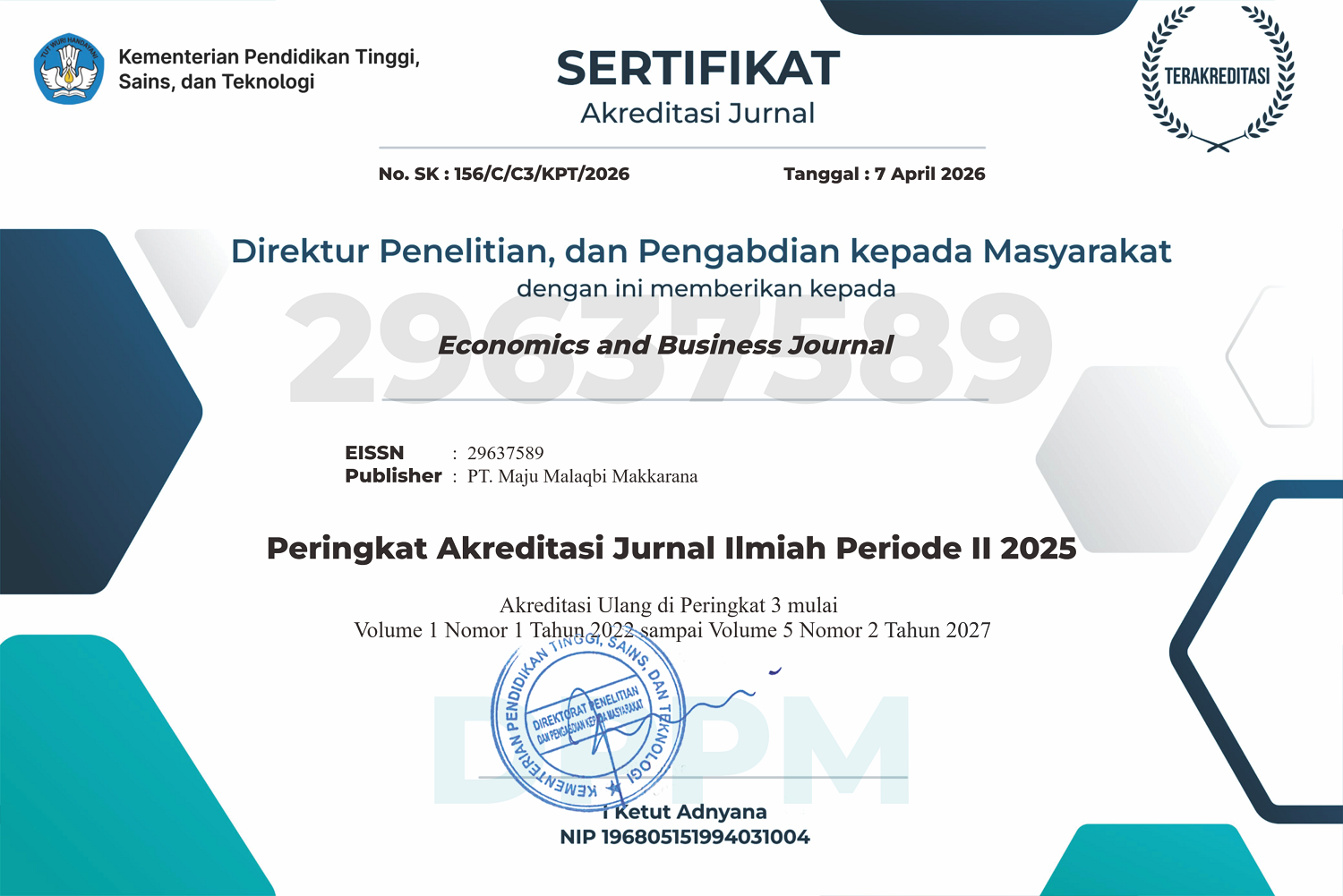

Analysis of Non-Cash Transactions, Debit Cards, Credit Cards, and Electronic Money, on the Money Supply in Indonesia
DOI:
10.47353/ecbis.v2i1.104Published:
2023-11-14Downloads
Abstract
This study was conducted to determine the effect between the independent variable, namely non-cash transactions (debit card transactions, credit card transactions, and electronic money transactions) on the dependent variable, namely the Money Supply (M1) in Indonesia. The research was conducted using a quantitative approach and the type of research used secondary data in the form of time series data from 2012-2021 obtained from Bank Indonesia and the Central Bureau of Statistics. The purpose of this study is to determine the effect of non-cash transactions on the money supply in Indonesia during 2012-2021. The analysis model used is multiple linear regression using SPSS. This study also uses the statistical t test, statistical F test, and the coefficient of determination R2. Based on the results of the research that has been done, it shows that debit card transactions have a positive effect on the amount of money in circulation and credit card transactions have a negative effect on the money supply in 2012-2021. Meanwhile, electronic money transactions have no effect on the money supply in 2012-2021
Keywords:
Cashless Transactions Debit & Credit Cards Electronic MoneyReferences
Abidin, M. S., (2015). Dampak Kebijakan Electronic Money di Indonesia Sebagai Alat Sistem Pembayaran Baru. Semarang: Universitas Negeri Semarang.
Aminy, A. R. (2022). Analysis of Influence of Card-Based Payment and Electronic Money on Money Supply. 3(1), 48–56.
Asfia, M. (2009). Ekonomi Makro. PT Refika Aditama.
Azhar, Z., Putra, H. S., & Huljannah, M. (2020). Implications of Using E-money and APMK on the Money Supply : The Case of Indonesia. 152, 209–220.
Azka, A. (2017). Pengaruh Penggunaan Alat Pembayaran Menggunakan Kartu Terhadap Jumlah Uang Beredar Di Indonesia (Periode 2015 – 2016).
Bambang, P., Yanuarti, T., Purusitawati, P. D., & Emmy, Y. T., D.K., (2006). “Dampak Pembayaran Non Tunai Terhadap Perekonomian dan Kebijakan Moneter”, Working Paper Bank Indonesia, Nomor 11 September 2006.
Bank Indonesia. (2012). Peraturan Bank Indonesia Nomor 14/2/PBI/2012 tentang Penyelenggaraan Alat Pembayaran dengan Menggunakan Kartu.
Costa Storti, C., & De Grauwe, P. (2001). Monetary Policy in a Cashless Society (SSRN Scholarly Paper No. Centre for Economic Policy Research).
Firmansyah, & Dacholfany, I. (2018). Uang Elektronik Dalam Perspektif Islam. (Dini Handoko, Ed.) Metro, Lampung.
Hidayati, S., Nuryanti, I., Firmansyah, A., Fadly, A., & Darmawan, I, Y., (2006). Kajian Operasional E-Money Bank Indonesia. Bank Indonesia.
Ismanda, F. (2019). Analisis Pengaruh APMK dan E-Money sebagai Instrumen Pembayaran Non Tunai Terhadap Tingkat Suku Bunga dan Pertumbuhan Ekonomi di Indonesia. Jurnal Dinamika Ekonomi Pembangunan, 2(2), 202–212. https://doi.org/10.33005/jdep.v2i2.94
Lintangsari, N. N., Hidayati, N., Purnamasari, Y., Carolina, H., & Ramadhan, W. F. (2018). Analisis Pengaruh Instrumen Pembayaran Non-Tunai Terhadap Stabilitas Sistem Keuangan Di Indonesia. Jurnal Dinamika Ekonomi Pembangunan, 1(1), 47. https://doi.org/10.14710/jdep.1.1.47-62
Lubis, N. (2019). Pengaruh Sistem Pembayaran Non-Tunai Pada Era Digital Terhadap Tingkat Inflasi Di Indonesia. Medan: Universitas Muhammadiyah Sumatera Utara.
Novitasari, E. (2019). Pengaruh Alat Pembayaran Menggunakan Kartu (APMK) dan E-Money Terhadap Jumlah Uang Yang Beredar Periode Tahun 2014-2018. Bekasi: Universitas Pelita Bangsa
Rahardja, P., & Manurung, M. (2008). Pengantar Ekonomi (Mikroekonomi dan Makroekonomi). Jakarta: Lembaga Penerbit Fakultas Ekonomi Universitas Indonesia.
Panjaitan, C. (2021). The Influence of the Non-Cash Payment System on the Money Supply in Indonesia. 7, 62–79. www.bi.go.id
Puspitasari, A. N. F., Rotinsulu, T. O., & Niode, A. O. (2021). Analisis Pengaruh Transaksi Pembayaran Non Tunai Terhadap Jumlah Uang Beredar M1 di Indonesia Tahun 2009-2019. Jurnal Emba: Jurusan Ekonomi Pembangunan, Fakultas Ekonomi Dan Bisnis, Universitas Sam Ratulangi, 9(2), 523–532.
Sahabuddin, R., Arief, A. A., Rauf, D. I., Sukiman, & Muhammad, A. F. (2023). Kualitas Pelayanan Anggota Koperasi Pegawai Republik Indonesia (KPRI) Universitas Negeri Makassar Ditinjau dari Kemampuan Manajerial dan Kinerja Karyawan. SKETSA BISNIS, 10(2), 214-235. https://doi.org/10.35891/jsb.v10i2.4342
Salimah, S., & Wahyuningsih, D. (2020). Analisis Pengaruh Instrumen Pembayaran Non-Tunai Terhadap Stabilitas Sistem Keuangan di Indonesia. Buletin Ekonomi Pembangunan, 1(1), 31-44.
Sari, D. K. (2020). Analisis Pengaruh Transaksi Pembayaran Non Tunai Terhadap Jumlah Uang Beredar Di Indonesia. Journal of Economics Development Issues, 3(2), 361–376. https://doi.org/10.33005/jedi.v3i2.68
Wicaksono, F. A., & Huda, S. (2023). Analisis Pengaruh Alat Pembayaran Menggunakan Kartu (APMK), Instrumen Uang Elektronik, Bank Indonesia-Real Time Gross Settlement (BI-RTGS) Terhadap Jumlah Uang Beredar. Jambura Economic Education Journal, 5(1), 11-21.
Wijaya, Y. A., Mukhlis, I., & Seprillina, L. (2021). Analisis pengaruh E-money, volume transaksi elektronik dan suku bunga terhadap jumlah uang beredar di Indonesia pada masa sebelum dan sesudah pandemi COVID-19. Jurnal Ekonomi, Bisnis Dan Pendidikan, 1(2), 135–145. https://doi.org/10.17977/um066v1i22021p135-145
Wijayanta, B., & Widyaningsih, A. (2007). Ekonomi & Akuntansi: Mengasah Kemampuan Ekonomi. Bandung: PT Grafindo Media Pratama.
Yilmazkuday, H. (2006). The Effects of Credit and Debit Cards On the Money Demand of a Small Open Economy. Preliminary journal.
License
Copyright (c) 2023 Sri Astuty

This work is licensed under a Creative Commons Attribution-ShareAlike 4.0 International License.
Downloads
How to Cite